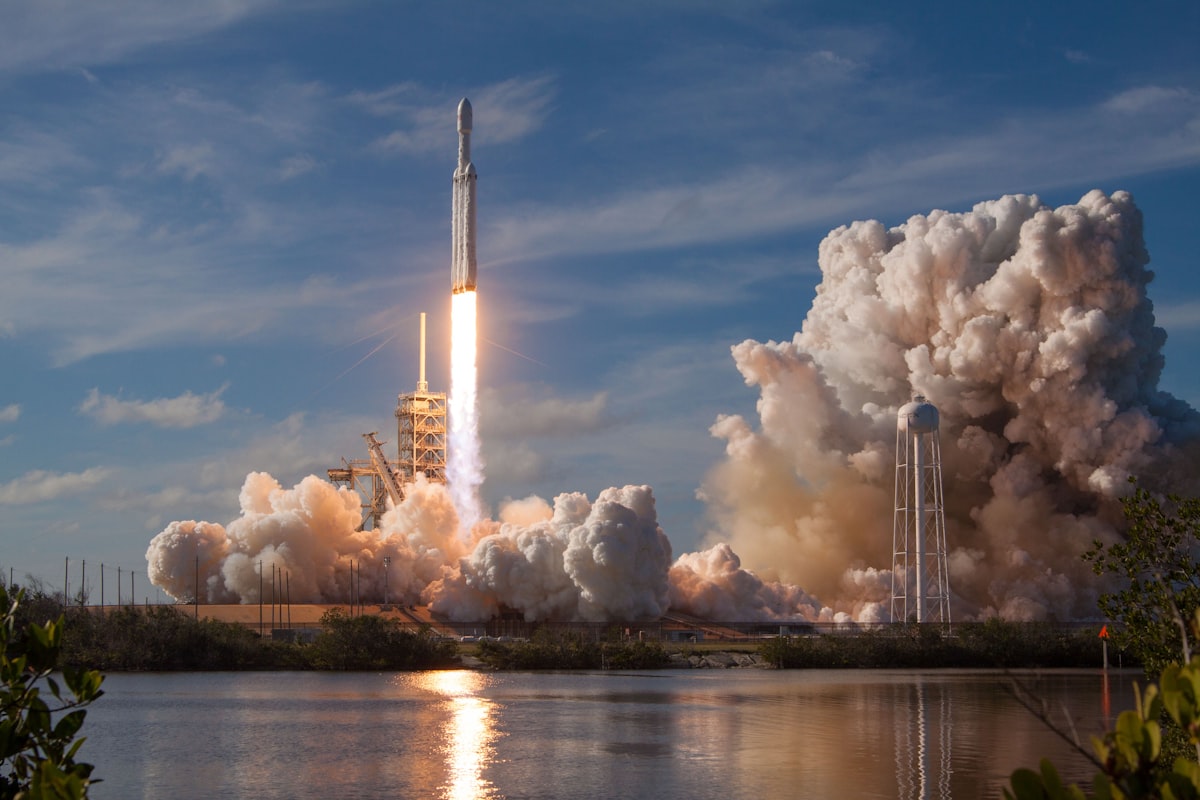
The American commercial launch industry has undergone a revolutionary transformation over the past decade, driven by reusable rocket technology, competitive pricing, and vertical integration. This analysis examines the market forces, technological innovations, and strategic dynamics reshaping access to space.
The Reusability Revolution
SpaceX's successful development and operational deployment of reusable orbital-class rockets fundamentally altered launch economics. The Falcon 9's first stage can now fly 15+ missions with minimal refurbishment, dramatically reducing per-launch costs:
- Traditional Expendable: ~$150-200 million per launch (Atlas V, Delta IV)
- Falcon 9 Reusable: ~$67 million per launch (commercial pricing)
- Falcon 9 Expendable: ~$97 million (maximum performance missions)
- Cost Per Kilogram to LEO: Reduced from $10,000+ to under $3,000
Economic Impact of Reusability
Reusable launch systems achieve cost savings through multiple mechanisms. First-stage recovery eliminates the largest single-mission expense—manufacturing nine Merlin 1D engines and the aluminum-lithium airframe. SpaceX has demonstrated that refurbishment costs (inspections, engine replacements, propellant loading) represent only 20-30% of new production costs.
However, reusability imposes performance penalties. Retaining propellant for boostback, entry, and landing burns reduces payload capacity by 30-40% compared to expendable mode. This trade-off makes economic sense only when launch cadence supports amortization across multiple flights.
Market Dynamics and Competition
The commercial launch market now operates on three tiers, each serving distinct customer segments:
Heavy-Lift Market
SpaceX's Falcon Heavy dominates with 64 metric tons to LEO capability at approximately $150 million per launch—less than half the cost of United Launch Alliance's (ULA) Delta IV Heavy. ULA's new Vulcan Centaur offers improved economics through Blue Origin BE-4 engines and simplified operations, but cannot match Falcon Heavy's reusability advantages.
Medium-Lift Market
This segment sees the most intense competition:
- SpaceX Falcon 9: Market leader with 60+ annual launches and proven reliability
- ULA Vulcan Centaur: Recently operational, targeting national security payloads
- Rocket Lab Neutron: In development, targeting 13 metric tons to LEO with partial reusability
- Blue Origin New Glenn: 45 metric tons to LEO, reusable first stage, targeting 2025 debut
Small-Launch Market
Dedicated small satellite launchers face challenging unit economics. Rocket Lab's Electron (300 kg to LEO) charges $7-8 million per launch—significantly more expensive per kilogram than rideshare options on Falcon 9. Virgin Orbit's bankruptcy in 2023 demonstrated that air-launch systems struggle to achieve profitability without substantial payload volume.
Vertical Integration Strategy
SpaceX's success stems partly from aggressive vertical integration. The company manufactures approximately 80% of components in-house, including:
- Merlin and Raptor rocket engines
- Avionics and flight computers
- Tank structures and pressure vessels
- Fairing composites and separation systems
- Grid fins and landing legs
This approach reduces supply chain delays, accelerates iteration cycles, and captures margin that would otherwise flow to subcontractors. Traditional aerospace primes like Boeing and Lockheed Martin maintain extensive subcontractor networks, adding overhead and complexity.
Starship: The Next Paradigm Shift
SpaceX's Starship system represents an attempt to reduce launch costs by another order of magnitude through full reusability of both stages:
"If Starship achieves operational status with rapid reusability, it could reduce cost per kilogram to orbit below $200—fundamentally changing what's economically feasible in space."
Technical Specifications
- Payload Capacity: 100-150 metric tons to LEO (fully reusable)
- Propulsion: 33 Raptor engines on Super Heavy booster, 6 on Starship upper stage
- Propellant: Liquid methane/liquid oxygen (enabling Mars ISRU)
- Diameter: 9 meters (vs. 3.7m for Falcon 9), enabling large integrated payloads
Development Challenges
Starship's development faces significant technical hurdles. Rapid unscheduled disassemblies during test flights revealed issues with stage separation dynamics, heat shield tile adhesion, and engine reliability at scale. The vehicle requires orbital refueling—a capability never demonstrated—to deliver payloads beyond LEO.
FAA licensing represents another constraint, with environmental reviews and mishap investigations creating multi-month gaps between test flights. SpaceX's iterative test-to-failure approach conflicts with traditional regulatory frameworks designed for expendable vehicles.
National Security Launch Competition
The U.S. Space Force's National Security Space Launch (NSSL) program guarantees launch contracts to maintain industrial base diversity. Phase 2 awards split missions 60/40 between SpaceX and ULA through 2027, with Phase 3 procurement opening to additional providers.
This policy ensures that military and intelligence payloads aren't dependent on a single provider, but it maintains higher-cost launch options through guaranteed demand. Blue Origin and Rocket Lab are positioning for Phase 3 awards, though meeting national security certification requirements (payload fairing size, orbital injection accuracy, on-orbit maneuvering) presents substantial barriers.
International Competition and Export Controls
U.S. launch providers face limited international competition due to ITAR restrictions on American satellites and spacecraft. European Ariane 6 and Japanese H3 serve primarily government and allied commercial customers. China's Long March family offers competitive pricing but faces U.S. export restrictions and concerns about technology transfer.
SpaceX's dominance in the commercial market has effectively sidelined European commercial launch aspirations. Arianespace's business model—cross-subsidizing commercial launches with government funding—cannot compete with SpaceX's low marginal costs and high flight rate.
Future Market Evolution
Several trends will shape the next decade of commercial launch:
Point-to-Point Transport
SpaceX has proposed using Starship for terrestrial cargo delivery and passenger transport, with sub-hour flight times between global city pairs. This application requires solving reentry heating, sonic boom mitigation, and safety certification challenges that exceed current human spaceflight standards.
On-Orbit Refueling Infrastructure
NASA's Artemis program and military space architecture concepts depend on orbital propellant depots. Demonstrating reliable cryogenic fuel transfer and long-duration storage will enable new mission profiles, including reusable space tugs and orbital transfer vehicles.
Mega-Constellation Support
Starlink, Amazon's Project Kuiper, and similar constellations require hundreds of annual launches. This guaranteed demand sustains high production rates and enables aggressive pricing for secondary payloads. The launch industry is effectively bifurcating into constellation deployment services and premium dedicated launches.
Conclusion
The commercial launch revolution has fundamentally altered space access economics, driven primarily by reusability innovation and vertical integration. SpaceX's market dominance reflects genuine technological and operational advantages rather than simply aggressive pricing.
However, several uncertainties remain. Can competitors develop cost-competitive reusable systems? Will Starship achieve operational reliability and rapid reusability? How will export controls and national security requirements shape market structure?
The next five years will determine whether the launch market continues consolidating around SpaceX or whether new entrants can establish sustainable business models. For customers, the current environment offers unprecedented access to space at declining costs—a trend that shows no signs of reversal.